| Can we really go to
the moon? An essay. By J. G. Shinn |
|
| I think there are enough
people living today that can testify that the National Aeronautics and Space
Administration(NASA) did build a rocket, and that NASA did, in fact, launch
that rocket at least into Earth orbit. They will even tell you that
when it lifted off the ground they could feel the earth shake from miles
away. This was perhapes the most difficult part of the journey.
The easy part was actually getting to the moon from earth orbit. The moon is only about 240,000 miles away. Ask any amateur radio operator who has used it to bounce radio signals back to earth. They get about a 2 second delay depending on where the moon is in its orbit. We know that light travels 186,000 miles per second. Divide 240,000 by 186,000 and you get the average time it takes the radio signal to go from earth to the moon one way. About 1.29 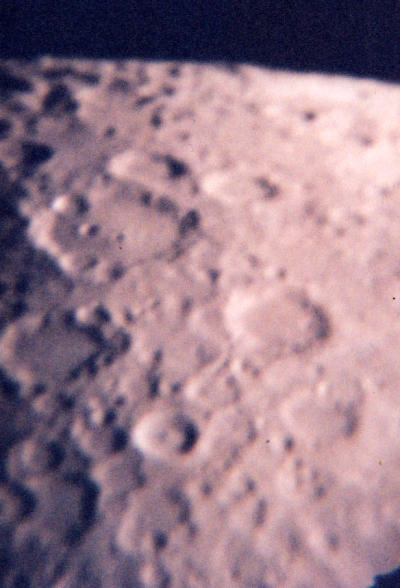 seconds. Multipy that by 2 for round trip
and you get a 2.58 second delay. Even if we didnt know the exact distance
to the moon by radio measurment, we could still infer that the moon is very
near to us buy just observing the motions of the heavenly bodies in the
sky.
seconds. Multipy that by 2 for round trip
and you get a 2.58 second delay. Even if we didnt know the exact distance
to the moon by radio measurment, we could still infer that the moon is very
near to us buy just observing the motions of the heavenly bodies in the
sky. Gravity attracts everything to everything in the universe. The larger the body the bossier it becomes to the smaller bodies. We can show by simple observation of the phases of the moon, its path through the plane of the ecliptic, and the motions of the planets, that the moon revolves around the earth. How, you may ask? All of the stars visible to us with the unaided eye do not display motion over periods of single or tens of years but rather thousands of years. This gives us a way of measuring the motions of the planets in our solar system, which display motion on scales of days and single years. Watch the motion of the moon relative to the background of stars. Compare it to the motion of the sun. It takes the sun a full year, a little more than 365 days, to return to the same position relative to the background of stars. The moon takes much less time. A bit more than 29.5 days. This has to mean that the sun is much farther from the earth than the moon. Because an object orbiting farther away takes longer to complete its orbit. The distances traveled are greater because of the increase in the diameter of the eliptical path around the object. We also observe that the inner planets are never seen at midnight in the night sky and display the same phases as the moon. With the exception that we never see them full, and sometimes observe their shadow, or "new" phase, crossing the disk of the sun. The outer planets, on the other hand, always appear to be full. Because light travels in a straight line, away from the sun, illuminating each planet on the side faceing it. With this we can place ourselves somewhere behind the inner planets, and in front of outer planets, orbiting the sun. The moon itself then gives us a clue that it is indeed gravitationally bound to our planet by the simple fact that we see the full range of phases. A full moon, while the sun is directly opposite its position in the sky, and a new moon when on occasion it eclipses the sun. Telescopic observation should also be convincing enough to say it is relatively close to us. No other heavenly body displays such a wealth of stunning detail through the eyepiece. Now that we know and accept that the moon is at minimun an average distance of 240,000 miles from us. Lets ask ourselves how long it would take to drive there? Imagine NASA built us a very long highway to the moon. I think if you are like most of us we like to drive an average 70 miles per hour on the highway. So if we divide 240,000 miles by 70 mph we get how many hours it will take us to drive in a straight line to the moon. About 3429 hours or 142 days. Wow only about 4-5 months in a car! About the same time some sea voyages took in the 17th century. Ok so we see that 70 mph is kinda slow and definatly not fast enough to lift us into earth orbit. Anything in orbit above us needs to be going at least 17,000 mph to keep from falling back into the earth. The object of orbiting being to have enough velocity to fall around a planetary body, in this case, the earth. Imagine standing on Mount Everest and throwing a ball so fast that, as it falls to the ground, it will never touch the surface because the curve of the ball toward the ground is the same as the curve of the earth itself! This is how all satellites and rocket ships stay up in the sky. And as we stated before. The velocity neccessary to maintain that curve is no less than 17,000 mph. So NASA at least launched a rocket into earth orbit. Only 240 miles or so above the earth. Say we travel in a straight line from earth to the moon at 17,000 mph. Divide 240,000 by 17,000 and it will only take you FOURTEEN HOURS TO GET THERE! WOW! What a difference a little hydrogen and oxygen in the fuel tanks can do. We have a problem. We still cant get to the moon going only 17,000 mph. Earths gravity is still pretty strong and we are locked into a virtually endless circling of the earth. We will have to reach what is called escape velocity. This is the speed we need to be going in order to break free of earth's gravity and on to some other place in the universe. That speed is about 25,000 mph. But here is the really cool and easy part. Newtons first law states that all moving objects will continue to move in a steady straight line unless acted upon by some outside force. Our moon rocket is doing precisely that in earth orbit. It is high above any immediate drag effects of our atomosphere. (Believe it or not there is some drag but not enough to cause any appreciable problems in the near future.) It is doing just what Sir Newton has said we should observe it to do. Continue in a straight line. BUT WAIT! Its not going in a straight line! Isn't it CURVING AROUND THE EARTH? Yes! it is indeed. But it is also traveling in a straight line. Here is were Mr. Einstein comes in. Einstein says "Yea its going straight." "How?" you ask. Einstein says we should look at gravity not as a force, like Newton, but as the bending of space itself. So that the rocket is indeed traveling straight but the mass of earth has bent all straight lines of travel into itself! This means any body at rest, without motion, relative to the earth will follow these paths to the ground, i.e. fall. A rocket in orbit stays up because its velocity and path through space, relative to earth, prevent it from falling back into the earth. So now all we need to do is point our rocket away from that path around the earth and go, right? Well kinda yea and kinda no. Really, all we have to do to raise or lower a rockets orbit, or escape a planetary body altogether, is adjust our rockets speed at the right time and the right place. We cant just point our rocket at the moon, press a button, and go. We have to make sure we understand where we are in the earths gravitational "well", where the moon will be once we reach its orbital domain, and how much fuel we need to travel there. Once we are in the right position at the right time, all we have to do is press the button to turn our rocket engine on, and wait for our engine to accelerate us to about 25,000 mph and we are off to the moon! As you can see its a very simple idea but a very mathmatical process. Of course the fact that we have live people on board makes it a bit more complicated what with life supports systems and the inherent dangers to life in space. Take for instance the radiation belts. Would'nt they cause severe problems with computer chips and human DNA? Potentially, yes. But going through them at 25,000 mph is much safer than going through them at 70mph. Since radiation damage gets worse with timed exposure the couple of minutes spent in them dosent amount to much. Say we have a radiation zone 4,000 miles thick. If we shoot through it at 25,000 mph we will have only spent 10 minutes in them. You have to remember that, although it dosent seem like it, there is alot of space between the atoms in your body. Its been said that if the nucleus of an atom consisted of basketball sized protons and neutrons, placed at the center of the earth, the electron would be found somewhere in the atmosphere. The radiation in the Van Allen Belts are in the form of protons, electrons, and ions. Most of which will pass through you without hitting a single atom. The ones that do hit can knock your DNA for a loop or cause problems in the tiny electronics of the spacecraft. Spending less time in a radiation invironment reduces the chances your molecules will be hit by a passing particle. What about the sun? Dosent it pose a radiation danger? Of course. But remember also that the sun has an 11 year sunspot cycle where, toward one end, it develops huge dark spots on its surface that can cause major solar radiation storms. At solar maximum some of these storms are so strong that they can fry satellites (electronically) and cause power surges in power grids here on earth. Any astronouts on the moon would certainly be dead because, unlike the earth, the moon has no magnetic field to protect them. At the other end of the 11 year cycle the sun has almost no sunspots and major solar storms are very few and far between, if any at all. While the Apollo program was underway the sun was in this solar minimum state. One interesting note though. It has been reported that sometimes the astronouts saw tiny flashes of light when they closed their eyes because cosmic rays were interacting with their retinas. we are now on the way to the moon. We understand what we need to do to go there. The way gravity works, how to orbit a planet, and the radiation dangers. What do we do when we get there? Well, we are going way to fast. We need to slow ourselves down. The energy, or velocity, we needed to escape earths gravity is to much for the weak gravity of the moon to capture us. So we need to turn our engine facing the direction we are heading and fire it once more so that we can slide into a nice safe lunar orbit. Once that is completed we can begin the process to walk on the moon. Since the moon has only 1/6 of the gravity of earth, its not necessary to have a huge rocket to take us down and up from the surface. Had the moon been as large as earth we would have taken a very different approach to landing people there. Who knows had the moon been like earth we may have discoverd life there or it may have discoverd us! But alas the moon is so small that there is no atmosphere and nothing but rocks, dust, and meteorite craters on its surface. Time for the return home. This has got to be complicated, right? Not really. Remember that the earths gravity is much stronger than the moon. So really the only fuel we need is for freeing us from the lunar gravity field and making course corrections along the way. Its practically a free ride! Fire your engine at the right time and place, and you can drift all the way back. Burning fiercly into the atmosphere and finally to a nice gentle parachute landing in the ocean. The brave astronauts of Apollo 13 used this "free ride" trajectory to return safely to the earth. I hope you've had as much fun and facination reading this essay as I had writting it. I invite you to go to your nearest astronomy club or public observatory and ask to view the moon some night. Its best viewed around the first or last quarter when you can see shadows cast by the craters and mountains at lunar dusk. Its a wonderful experience you will not soon forget. |
|
POINTS AND CHALLENGES
|
|
|
THE AUTHOR:While I am an amateur astronomer. I have read many text on the subject of astronomy and space physics. I have also enjoyed reading material on the Apollo moon program as well as other NASA space endeavours. And I am prepared to share my knowledge, resources, and sources. Feel free to email me with any questions, contributions, and corrections. They are always welcome. |
|
| E-mail: | TrueMartian@aol.com |
| LINKS: |
NASA: The Great Moon
Hoax Bad Astronomy: Independant Site Redzero's MoonHoax: Independant Site |